

Middlemarch
A Slow Read

Welcome to The Reader & the Writer’s slow read of George Eliot’s Middlemarch!
Rhea here.
Shari and I look forward to spending the next eight months reading and discussing this classic with you: slowly, attentively, and in community. We are reading Middlemarch in much the same way it was originally published, one book a month. This pace allows us to take our time and fully examine the story and its deeper meanings.
RW’s “Welcome to Middlemarch” episode airs 1/13/26—no reading required. After that, episodes will air on the first Friday of each month and cover the previous month’s reading.
We invite you to use this page as a “landing site” for our journey together. Below, you’ll find our reading schedule, bookmarks, what to look for as you read, as well as additional resources that either Shari or I have found useful.
Our hope is that this page will help facilitate in-person book discussions with people in your community.

“A really great novel can work in this uncanny way upon us. It can give us the sense that we are being read by it—that we are being moved to new understandings of ourselves, and of those people around us.”
Rebecca Mead, xii

Each month’s podcast discussion explores the reading from the previous month.
Jan 13: Welcome to Middlemarch
Feb 6: Middlemarch - Book 1
Mar 6: Middlemarch - Book 2
Apr 3: Middlemarch - Book 3
May 1: Middlemarch - Book 4
Jun 5: Middlemarch - Book 5
Jul 3: Middlemarch - Book 6
Aug 7: Middlemarch - Book 7
Sep 4: Middlemarch - Book 8

We’ve created two sets of bookmarks to help track your reading each month: one for the lover of all things pretty and another for those who prefer to save ink! We’ll release the next set in April.


As the podcast episodes are released, they will be linked below.


1st Gent. Our deeds are fetters that we forge ourselves.
2nd Gent. Ay, truly: but I think it is the world that brings the iron.
Middlemarch | Chapter 4 epigraph

Join the conversation for each book here. Make sure to pop into the Book 1 chat and introduce yourself.
Book 2
Week 1 | Chapters 13 - 14
Week 2 | Chapters 15 - 17
Week 3 | Chapters 18 - 19
Week 4 | Chapters 20 - 22
Book 3
Week 1 | Chapters 23 - 25
Week 2 | Chapters 26 - 28
Week 3 | Chapters 29 - 31
Week4 | Chapters 32 - 33

This section is meant to guide your reading and support in-person discussions of Middlemarch. These themes and questions will shape our conversations on the podcast as we journey through the novel.
To get the most of your reading experience, consider keeping a reading journal. Keep all your questions, curiosities, character sketches, chapter notes, favorite quotes, additional research… all of it!
For suggestions on annotating as your read, check out Shari’s post, On Note-taking As You Read:

_(attributed_to)_-_Coventry_-_VA.1959.0019_-_Herbert_Art_Gallery_and_Museum.jpg)
About our Narrator
As you’re reading, here are some things to notice and consider about Middlemarch’s narrator:
The narrator of Middlemarch has been called “large-minded.” Where do you see this large-mindedness in the narrator?
Where do you see the narrator exploring ideas throughout the story in a “spirit of criticism?” What are the concerns of the narrator and how does she/he present them?
How are we challenged by the narrator’s commentary?
Where do you see the narrator being understanding and sympathetic?
Consider how the narrator presents characters: How do we get introduced to them? How do we get to know them? What points of view does our narrator offer us for understanding a character—from both an outside, and “inner space” perspective?
Intimately connected to our narrator is the author, George Eliot, behind the page. Look for the following aspects in the storytelling, and how they are woven into the characters’ lives, trajectories, opinions, and decisions:
Eliot as imaginative historian
Eliot as scientific investigator
Eliot as social commentator
Eliot as political analyst
Themes to Look for
George Eliot called Middlemarch the “home epic.” Rebecca Mead, in her 2015 Forward to the Penguin Classic Edition1, calls this “a magnificent turn of phrase that perfectly captures the way in which the everyday experience of love, work, and family relations marry the mundane the sublime.” (xi)
Here are themes to follow and watch develop:
Unfulfilled aspirations
Money trouble
Humanism as an ideal (Look under “additional resources” below to read more about Eliot’s humanist’s beliefs)
Marriage
Role of Women
“Home as a seeding ground”
Here are some extended metaphors Eliot employs in her theme development:
Medical
Scientific
Labyrinths
Yokes or harness
webs
Threads of connection
Middlemarch is full of “fresh threads of connection,” (from Ch. 11 of the novel) particularly for its time and place in Victorian England. Look for ways Eliot is expressing new connections between:
Men and women
bourgeoisie and country gentry
doctors and patients
political candidates and voters
Miss Brooke as a bridge to middle-class
Mr. Brooke as a useful plot mechanism: country gentry with one foot in social change in strange ways.

As the year progresses, we will add articles, videos, and links pertaining to Middlemarch.
Author Background
George Eliot | Wikipedia
George Eliot’s belief in Humanism | Humanist Heritage UK (online)
Clare Carlisle | The Marriage Question: George Eliot's Double Life, with Christine Smallwood | The New York Society Library
Clare Carlisle, professor of philosophy and author of books on Spinoza and Kierkegaard, discusses her new biography with novelist and editor Christine Smallwood.
Historical Context
How Medieval England Transitioned to the Industrial Age | Absolute History
Tony Robinson explores the birth of the Industrial Revolution. He takes a 40-mile walk through the glorious Peak District, along the Derwent Valley, where the world's industrial revolution was born.
Exploring Eliot | “Finding Middlemarch”
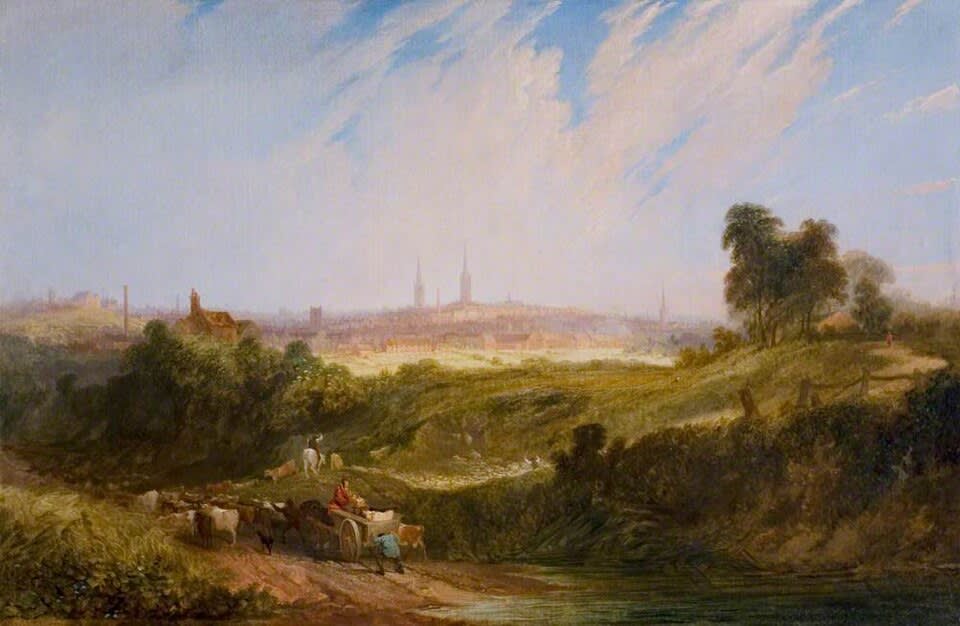
This online exhibition, curated by Dr Rosalind White (Royal Holloway, University of London) opens out the history of nineteenth-century Coventry through the lens of George Eliot’s Middlemarch: A Study of Provincial Life (1871).
The Reform Act of 1832 | UK Parliament
This link helps provide context for the Reform Act of 1832, which redistributed parliamentary seats and expanded the vote to more men while most working men and women remained excluded.
Below are some of the names and events mentioned in Middlemarch. Click the links if you’d like to learn more. As we read, this list will be updated.
Robert Peel | Chapter 6
Guy Faux [Fawkes] | Chapter 6
Suggested Further Reading
Victorian People and Ideas: A companion for the modern reader of Victorian Literature by Richard D. Altick
George Eliot: Thames and Hudson - Literary Lives Series by Marghanita Laski
Literature and Science in the Nineteenth Century: An Anthology edited by Laura Otis | Oxford World Classics
What Jane Austen Ate and Charles Dickens Knew by Daniel Pool (thank you Debbie Messimer for this suggestion!)
Rabbit Holes
Here you’ll find links to the rabbit holes either Shari or I fell down while reading. Let’s be honest, it will be mostly from me (Rhea)! 😂
“Middlemarch: Epigraphs and Mirrors” by Adam Roberts (Rhea)
Epigraphs—I love them! I stumbled across this Substack article, and it turns out the author Adam Roberts wrote an ENTIRE book on the epigraphs in Middlemarch! I am anxiously awaiting my copy of the book. (Side note: He provides a link to a free downloadable copy—should you want to check it out before purchasing.)
“The Enclosure Act” | The History of Western Civilization (Rhea)
excerpt: “Enclosure, or the process that ended traditional rights on common land formerly held in the open field system and restricted the use of land to the owner, is one of the causes of the Agricultural Revolution and a key factor behind the labor migration from rural areas to gradually industrializing cities.”
This link helped me begin to piece together the complexities of land ownership in early 19th-century England, especially some of the social dynamics happening in the background of Middlemarch.
Eliot, George. Middlemarch : A Study of Provincial Life. New York, Penguin Books, 2015.