

Why Hannah Coulter?
Why does this story change me every time I read it?

Anyone who knows me (or who listens to the podcast) knows I don’t do favorites. I think it might drive Rhea crazy, but she patiently endures.
I don’t do favorites. Or so I say.
But then there is Hannah Coulter.
I don’t know why, but even at the mention of this novel, I feel an overwhelming swell of emotion; I have to clear my throat several times before I can even talk about it. Often, I can’t read passages from it aloud without a sudden urge to weep.
What is it about this story? Why does it call to this deep place inside me, begging a response? And when I say “response” I mean more than the emotion I described above. I try and try, but find there is no adequate language for responding that is worthy to the power and beauty of the call. How do I explain the kind of ache I feel in the very center of my chest every time I open this book and begin to read? How do I convey the kind of conviction I feel? The way I know what Hannah is saying in her remembering and writing it all down, without having lived through any of it except in my own ways: my own decades of hope and grief and oneness, of giving and receiving, gaining and losing, and continuing to wake up every day and live because “the light that shines in the darkness and never goes out” keeps calling me back to it. Not because of anything I do to make this happen, but because of the membership surrounding me, given to me as gift.
So even though I admit upfront I’m going to fail at this, I want to try and put to words over these next three weeks (the weeks we’re reading Hannah Coulter on The Reader & the Writer) why Hannah Coulter is such a monumental work to me.
In its beginning is its continuing…
“I picked him up in my arms and I carried him home.”
So Nathan would end the last of the stories of his childhood as he told it to our children.
This is how Hannah begins her story; with a story of her husband. Specifically, the last story he ever told their children about his childhood. It is the story of Nathan, at the age of sixteen, carrying his dying grandfather home in his arms, back to his grandmother, after his grandfather collapsed being outside in the heat. Hannah goes on to explain that after that story, Nathan told no more stories about himself. Hannah suspects this is because Nathan considered this the last day of his boyhood. After that, he was simply a man who lived and worked on the farm with his father and uncle, and this would be the way it was. But then the war came, and he, along with his older brother, Tom, was called to fight. Tom died. Nathan lived.
Hannah says she never knew Tom except for the stories Nathan told their children about him. And most all those stories were of their childhood, their goings on, happy and sad things alike. Because no one in the family could talk about Tom as they last knew him, so close to his death, to Hannah he lives on as a boy in the old stories her husband liked to tell.
And here I stop to wonder: How do I keep alive those beloved to me from my past? How do I keep alive those beloved of my beloved’s past? Do I even try?
The first time I read Hannah Coulter, I was familiar with its opening, as I had just finished Wendell Berry’s Nathan Coulter before reading Hannah. Nathan’s ending is Hannah’s beginning. That was so long ago now, I don’t remember if it struck me as odd that Berry would choose to have Hannah begin this long look back at her life with a contemplation of her husband and his life—specifically his own story telling. But, now, in this fourth reading of Hannah Coulter, I realize, it is sort of odd, is it not? Why not begin at the beginning, as she does in Chapter Two?
I was a Steadman from up in the ridges behind Hargrave. Dalton and Callie were my parents, and I was their only child.
By beginning with Nathan and this very specific scene from his childhood (or end of childhood, as she suggests), I am given over to this deep sense of Hannah quietly placing herself there with him, revealing her oneness with him, even though she never knew him until eight years later in 1948, and would have by then buried her own husband lost to war, and become a mother to a little girl, a child who’d “become half an orphan before [she] could be born.” (50)
There is much Hannah doesn’t know about her husband, Nathan, as he was not a man “with much extra to say,” especially when it came to his time in the war. After his death, she says she tried to learn as much as she could about the Battle of Okinawa where he’d fought, desiring to understand, but then learning more than she could easily bear.
Even after his death, this woman seeks to know her husband. To be one with him and live with all of him in her heart. Notwithstanding what she does not know, she is clear in stating that his story is her story too, after the war, and especially after 1948, because she lived it with him:
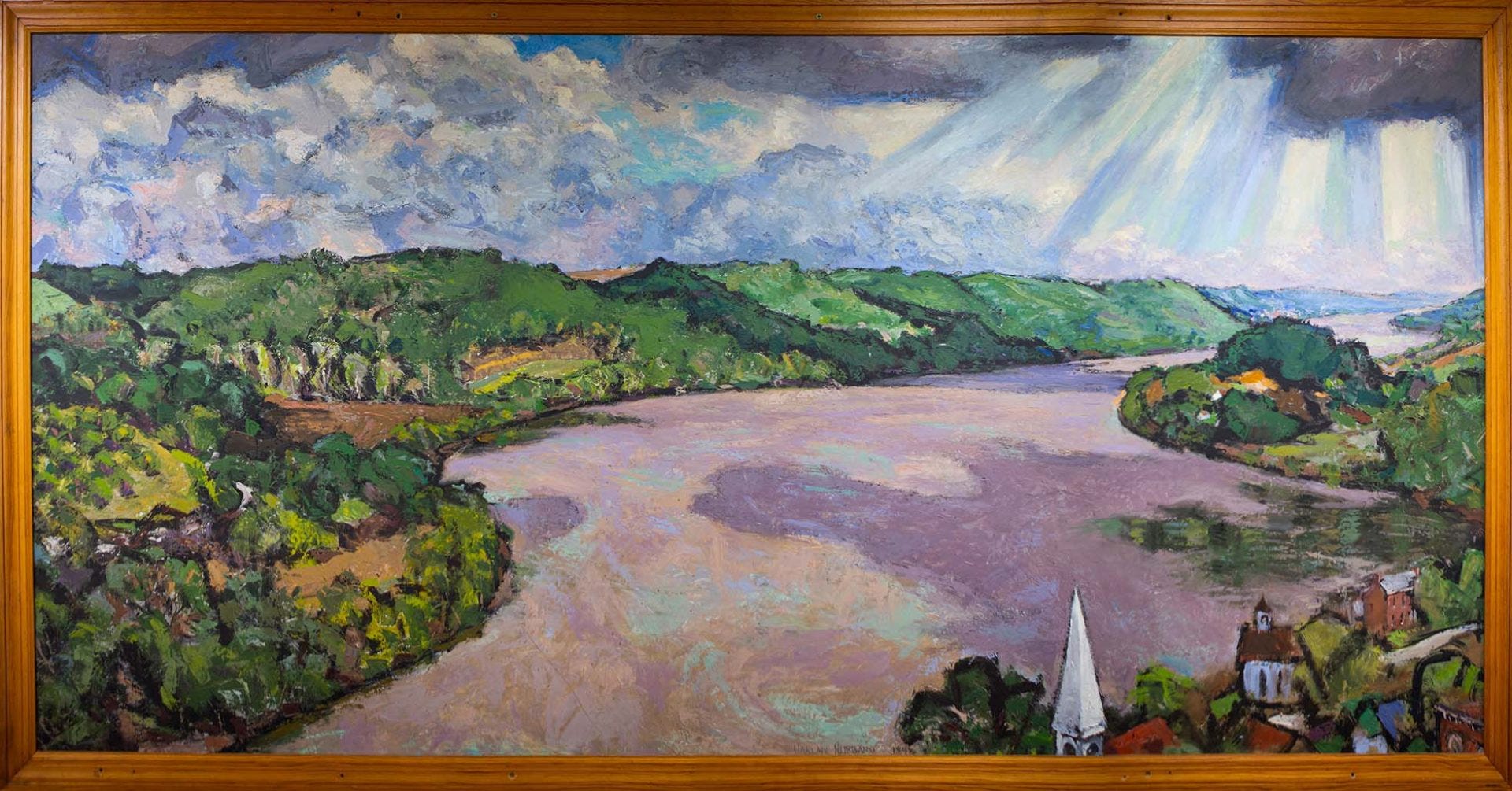
It is the story of our place in our time: our farm of “150 acres more or less,” as the deed says, on the ridges and slopes above the creek known as Sand Ripple that runs down from Port William to the river. Nathan bought it in that year of 1948 hoping I would marry him, or in case I would, thinking he would need a place of his own to take me to.
Our story is the story of our place: how we married and came here, moved into this old house and made it livable again while we lived in it; how we raised our children here, and worked and hoped and paid the mortgage, and made a pretty good farm of a place that had been hard used and then almost forgotten; how we continued, making our life here day by day, after the children were gone; how we kept this place alive and plentiful, seeing it always as a place beyond the war—Nathan seeing it, as I now think, as if from inside a fire; how we got old, and Nathan died, and I have remained on for yet a little while to see how such lives as our and such a place may fare in a bad time. (5)
Woven through these lines is their union; their oneness. But there is more here, too. There is woven through Hannah and Nathan’s story, the story of oneness itself:
“Therefore a man shall leave his father and his mother and hold fast to his wife, and they shall become one flesh.” —Genesis 2:24
It is this story of oneness: with one another and their land; one another and their children; one another and their place; one another and the membership of Port Williams; one another and their quiet steady faith in God… all these small trinities of belonging to one another in mysterious, poured out gratitude and love.
Along with this, is the language itself. Hannah pens these lines like a prophet and a priest, remembering and recounting the Lord’s great deeds, His wonder working power and eternal faithfulness for the sake of the ones He loves.
Here is a portion of Moses’s song near the end of Deuteronomy, sung to all of Israel as a testimony, just before his own death:
When the Most High gave to the nations their inheritance,
when he divided mankind,
he fixed the borders of the peoples
according to the number of the sons of God.
9 But the Lord‘s portion is his people,
Jacob his allotted heritage.10 “He found him in a desert land,
and in the howling waste of the wilderness;
he encircled him, he cared for him,
he kept him as the apple of his eye.
11 Like an eagle that stirs up its nest,
that flutters over its young,
spreading out its wings, catching them,
bearing them on its pinions,
12 the Lord alone guided him,
no foreign god was with him.
13 He made him ride on the high places of the land,
and he ate the produce of the field,
and he suckled him with honey out of the rock,
and oil out of the flinty rock.
And the psalmist (unnamed) in Psalm 105:
Oh give thanks to the Lord; call upon his name;
make known his deeds among the peoples!
2 Sing to him, sing praises to him;
tell of all his wondrous works!
3 Glory in his holy name;
let the hearts of those who seek the Lord rejoice!
4 Seek the Lord and his strength;
seek his presence continually!
5 Remember the wondrous works that he has done,
his miracles, and the judgments he uttered,
6 O offspring of Abraham, his servant,
children of Jacob, his chosen ones!……
He spread a cloud for a covering,
and fire to give light by night.
40 They asked, and he brought quail,
and gave them bread from heaven in abundance.
41 He opened the rock, and water gushed out;
it flowed through the desert like a river.
42 For he remembered his holy promise,
and Abraham, his servant.43 So he brought his people out with joy,
his chosen ones with singing.
44 And he gave them the lands of the nations,
and they took possession of the fruit of the peoples’ toil,
45 that they might keep his statutes
and observe his laws.
Praise the Lord!
Now read Hannah’s words at the end of Chapter One; her “why” for writing down the story of her life, now that she is close to that life’s end:
This is the story of my life, that while I lived it weighed upon me and pressed against me and filled all my senses to overflowing and now is like a dream dreamed. So close to the end now, what do I look forward to? “Today shalt thou be with me in paradise.” Some morning, I pray, I’ll have the good happiness of “the man who woke up dead,” who Burly Coulter used to tell about.
This is my story, my giving of thanks. (5)
I read these lines and all I hear is:
What shall I render to the Lord
for all his benefits to me?
13 I will lift up the cup of salvation
and call on the name of the Lord,
14 I will pay my vows to the Lord
in the presence of all his people….
I will offer to you the sacrifice of thanksgiving
and call on the name of the Lord.
18 I will pay my vows to the Lord
in the presence of all his people,
19 in the courts of the house of the Lord,
in your midst, O Jerusalem.
Praise the Lord! —Psalm 116
There is this profound way in which Wendell Berry, through Hannah’s story and her voice, reveals to me the Great Story all over again, reminding me that it is my story, too. It is my birthright and my call. Deep calls to deep, writes the psalmist to his Maker. By day He commands his steadfast love, at night his song is with me. By some great and beautiful mystery, when I read Hannah Coulter I can hear the deep call to me. I hear it and I respond even when there seems no evidence for the calling. It is like Hannah responding to the light, even after losing Virgil:
The living can’t quit living because the world has turned terrible and people they love and need are killed. They can’t because they don’t. The light that shines in the darkness and never goes out calls them into life. It calls them back again into the great room. It calls them into their bodies and into the world, into whatever the world will require. It calls them into work and pleasure, goodness and beauty, and the company of other loved ones. Little Margaret was calling me into life. A little ahead of me still, Nathan would be calling me into life. (57)
Trying to give shape of my own experience reading Hannah Coulter with words is, I think, a small part of my responding. It is my own “giving of thanks.”
There are other ways Hannah Coulter changes me every time I read it. And I will try in the coming weeks to articulate these. But here’s the thing: All the other ways rise and fall on this first way: by opening up the Great Story in a way so familiar and yet so new, Hannah calls me home. Home to my story in my place and time.
Which, of course, isn’t only mine anymore than it is only Hannah’s.
Have you read Hannah Coulter before? Have you read any Wendell Berry? I’d love to know what you find most impactful about his stories and his life.
If you haven’t yet listened to our first episode on Hannah Coulter, you can do that here:

And here is Rhea’s most excellent reading guide for Hannah Coulter:

This is amazing!
Wendell Berry is so wonderful!